History
of Sex in Cinema: The Early Days History
of Sex in Cinema: The Early Days
 Hollywood Seen as Sin City: Scandals Rock the Industry
 In
the early days of Hollywood shortly after the development of
film-making as an industry, moralists objected to the amount
of nudity, sexuality, criminality and violence portrayed in
films. Censorship boards were set up in various states and controls
began to be imposed, often on a voluntary basis, once moving
pictures became widespread and available to mass viewing audiences
(encouraged by the popularity of nickelodeons, first called
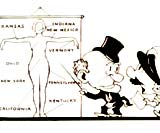
"arcade peepshows"). However, the vast complexity of various local, state and national censorship laws added to the problem of enforcement, i.e. in some states an ankle couldn't be displayed, or pregnancy couldn't be mentioned. In
the early days of Hollywood shortly after the development of
film-making as an industry, moralists objected to the amount
of nudity, sexuality, criminality and violence portrayed in
films. Censorship boards were set up in various states and controls
began to be imposed, often on a voluntary basis, once moving
pictures became widespread and available to mass viewing audiences
(encouraged by the popularity of nickelodeons, first called
"arcade peepshows"). However, the vast complexity of various local, state and national censorship laws added to the problem of enforcement, i.e. in some states an ankle couldn't be displayed, or pregnancy couldn't be mentioned.
To appease various groups worried about the powerful
effects of movies on the mainstream and growing resentment of the 'get-rich' quick Hollywood mentality, the film industry made
some efforts to self-censor its own production, worried that it might be shut down --- especially after
two very publicized cases that made headlines:
|
The Arbuckle Case: 1921
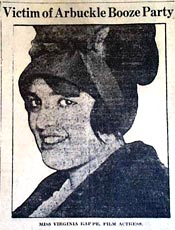
"Victim of Arbuckle Booze Party"
Miss Virginia Rappe, Film Actress
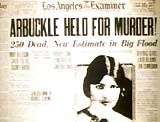
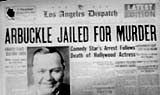
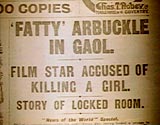
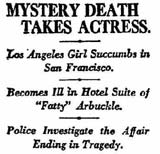
The infamous September 1921 Roscoe "Fatty" Arbuckle
scandal (he was accused of the rape and murder of young 30 year-old
starlet Virginia Rappe in San Francisco's St. Francis Hotel during a
party) landed the popular silent comedian in jail. Charges were reduced
to manslaughter and Arbuckle went on trial (there would be three trials).
Arbuckle was eventually fully acquitted
of the eventual manslaughter charge after three trials. The
third jury - after a six-minute verdict - stated: "Acquittal
is not enough for Roscoe Arbuckle. We feel a great injustice has been
done him. We wish him success and hope that the American people will
take the judgement of twelve men and women that Roscoe Arbuckle is entirely
innocent and free from all blame." However, Arbuckle's film career
was essentially over, although he sought to make a comeback as
a director, stage performer, and film actor. |
|
|
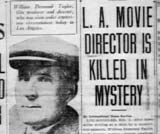
Murder of William Desmond Taylor: 1922
Further scandal erupted over the murder
of 49 year-old millionaire film director William Desmond
Taylor, popular comedian Mabel Normand's lover, in February
1922 - he was shot to death in his LA apartment after spending
the early evening with Normand. The murder was never solved,
although it appeared that Charlotte Shelby was a major suspect
-- the angry "stage mother" of 19 year-old blonde
starlet Mary Miles Minter who was seeing Taylor. The situation
was further complicated by rumors that Taylor was homosexual. |
|
Already, "America's Sweetheart" star Mary Pickford's
marriage to Douglas Fairbanks on March 28, 1920, after they
both divorced spouses to marry each other, was another symbol
of the erosion of values in Hollywood. Contrary to the scandalous affair, Pickford had always played innocent young women in her films, such as Rebecca of Sunnybrook Farm (1917) (the 25 year-old star portrayed a teenager), and in the year of the divorce-remarriage (when she was 28) portrayed a 12 year-old orphan in Pollyanna (1920).
Two other notorious death-murder cases caused serious
scandal in the 1920s, and then another one in the late 1940s:
|
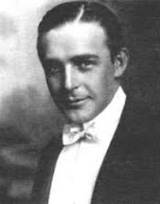
Death of Wallace Reid: 1923
Upright and popular silent film actor Wallace Reid
(also an alcoholic), dubbed "The King of Paramount," died in early
1923 at the age of 31. For years, he had been incurably addicted to
narcotics (morphine was secretly administered to him by the studio
after a train accident on the set during the making of the Lasky film The
Valley of the Giants (1919) in Oregon). Afterwards, he was continuously
supplied with morphine (and he became alcoholic), until he was forced
into rehab and reportedly ended his habit in 1922. However, his health
rapidly went in decline before his imminent death. His wife Dorothy
Davenport, another Hollywood star, preached that Reid's drug addiction
was a disease and not a sign of his moral depravity (commonly believed
at the time). [Note: The story of their marriage and the husband's
death was partially mirrored in A Star is Born (1937, 1954).] |
Wallace Reid
|
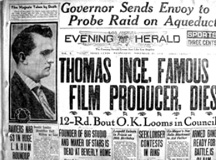
Death of Thomas Ince: 1924
Powerful producer
Thomas Ince died under mysterious circumstances in November
1924 on The Oneida yacht of publishing magnate William Randolph
Hearst, docked in the San Diego (California) harbor. [Note: Director Peter
Bogdanovich's The
Cat's Meow (2002) recreated
the murder and speculated on the case.] |
Death of Tomas Ince
|
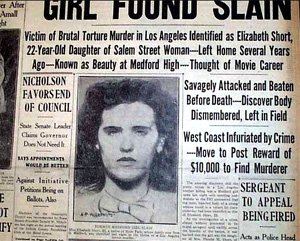
The Black Dahlia Murder Case: 1947
The infamous and unsolved
"Black Dahlia" murder case in early 1947, involving
the murder and dismembered mutilation of 22 year-old Elizabeth
Short, was seen as evidence of further major problems in the
film capital. [Note: Brian De Palma's noirish The Black Dahlia
(2006) was
adapted from the James Ellroy novel about the notorious case,
with Josh Hartnett and Aaron Eckhart as detectives, Scarlett
Johansson as Eckhart's sultry girlfriend, and Mia Kirschner as
the doomed starlet.] |
"GIRL FOUND SLAIN"
|
Early
Protest and Censorship Efforts: The Pre-Code Era
Censorship bills were introduced in many states and localities,
and in 1922, the Motion Picture Producers and Distributors of
America (MPPDA) was formed by the studios. Conservative former
Postmaster General William H. Hays was appointed to head the organization,
to begin efforts to clean up the motion picture industry before the public's
anger at declining morality depicted in films hurt the movie business.
Arbuckle Banished From Film-making (Temporarily)
One of his first acts of Hays in 'cleaning-up' Hollywood,
due to pressure from Hollywood's top film executives, was to banish
the acquitted actor-comedian Arbuckle from film, at least temporarily,
in order to distract the public. [Note: Arbuckle would continue to
make films as a director under the pseudonym William Goodrich between
1925 and 1932.]
Hays also approved the use of morality clauses in the
standard actor's contract, to control the conduct of performers, and
he also assured state and local censorship boards that he would properly
regulate the industry. |
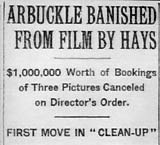
"Arbuckle Banished From Film By Hays"
|
The Beginning of the Hays Code
Other restrictions were instituted to regulate the content
of films and ban potentially objectionable themes (brutality, crime,
drunkenness, divorce, nudity and sex), such as those noted in Hays'
1927 list of "Don'ts"
and "Be Carefuls". The eleven "Don'ts"
included prohibition of profanity, suggestive nudity, use
of illegal drugs, sexual perversion, white slavery, miscegenation,
sex hygiene and venereal diseases, childbirth, children's
sex organs, ridicule of the clergy, and willful offense to
any nation, race, or creed.
The twenty-six "Be Carefuls" were
only cautionary, such as the elimination of the depiction
of criminality, excessive brutality, murder and rape, excessive
(over 3 seconds) and lustful kissing, and the depiction of
men and women sleeping together in the same bed. |
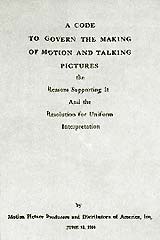
The Hays Code
|
Most studios basically ignored the regulatory restrictions,
because there was no enforcement that was effective, and they
knew that film-going audiences wanted to see the kinds of things
(sex and crime) that were being blacklisted. Also, some of these
illicit behaviors could be exhibited -- if later punished within
the film. A number of notable and successful films produced
in the early 30s before the Code was strictly enforced -- so-called
"bad girl" movies -- showed women using their sexuality
to get ahead, such as in the taboo-breaking comedy Red Headed
Woman (1932) starring Jean Harlow.
Additional Resources for the Pre-Code Era:
 A
number of excellent books have been written on the subject of
films in Hollywood's pre-Code era (1930-1934) before the period
of formal censorship began, and thereafter during the studio
era, including these selections: A
number of excellent books have been written on the subject of
films in Hollywood's pre-Code era (1930-1934) before the period
of formal censorship began, and thereafter during the studio
era, including these selections:
-
Complicated Women: Sex
and Power in Pre-Code Hollywood, by Mick LaSalle,
St. Martin's Press, 2001
-
Sin
in Soft Focus: Pre-Code Hollywood, by Mark Viera,
Harry N Abrams Publisher, 1999
-
Pre-Code
Hollywood, by Thomas Doherty, Columbia University
Press, 1999
-
Hollywood
Censored: Morality Codes, Catholics, and the Movies,
Cambridge University Press, 1996
-
Controlling
Hollywood: Censorship and Regulation in the Studio Era,
by Matthew Bernstein, Rutgers University Press, (Depth of
Field Series), 2000
History
of Sex in Cinema: The Hays Code and Censorship
The Legion of Decency and The Hays Code: An Era of
Censorship After Mid-1934

Three factors forced Hays and the studios to change: mounting
pressure from the Catholic Church aided by support from other
religious groups, economic hardships during the Depression,
and the threat of federal censorship. In 1934, the American
Catholic church announced the creation of the Legion of Decency,
which encouraged the production of moral films and promptly
condemned any film with an immoral message. The threat of movie
boycotts by the Catholic Legion of Decency led the industry's
trade association in mid-1934 to establish a stronger Production
Code Administration (PCA) Office, headed by appointee Joseph
Breen, to regulate films.
The Hays Code Seal of Approval
As a result of the "Hays"
Code being formalized, film scripts had to be approved before
production, and films had to be granted a PCA 'seal of
approval' - otherwise studios were heavily fined ($25,000)
and non-compliant films were prohibited from being released.
Theatres were not allowed to exhibit films that had not
been granted a seal. |
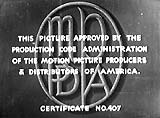
The Hays Code Seal of Approval
|
Interestingly, the Code forced
film producers to creatively sublimate sex and violence, to
reinvent themselves, and to find other alternatives to attract
patrons. Exploitation filmmakers made a number of "shock"
or "educational" independent films with socially inappropriate
content (in the guise of providing a public service), such as
Sex Madness (1937), The Birth of a Baby (1938),
and Child Bride (1938).
The latter was typical of an
exploitation film designed to circumvent the Production
Code restrictions with its plot that warned against underage
marriage. It was taken on road-shows enhanced by sensational
advertising and taglines ("Where Lust Was Called
Just") by legendary
roadshowman Kroger Babb, although it was banned in many
locations by local censors due to its infamous underage
nudity.
Other 'forbidden' films were usually screened
in theatres that came to be known as 'grindhouses' -
since they often served as burlesque strip joints. In
the early 1950s (during a period of very stringent decency
standards), pin-up queen Bettie Page and other burlesque
stars appeared in a "burlesque trilogy" of
vintage erotica, tauted as documentaries: Striporama
(1953), Varietease (1954),
and Teaserama (1955) -- these
were extremely tame although they were designed to titillate.
The Landmark Miracle Supreme Court Decision: 1952
Eventually,
the strict censorship and regulation system started to go into
gradual decline after World War II and as the 50s arrived. By
the mid-50s, the Production Code was partially rewritten to
allow, when "treated within the careful limits of good
taste", such previously banned topics as drug addiction,
prostitution and childbirth. A landmark Miracle Supreme
Court decision of the early 50s declared that films were protected
as 'free speech' by the First Amendment to the Constitution,
and most censorship was ruled unconstitutional.
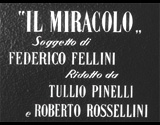 The
cornerstone decision came about regarding the showing of Italian
neorealist director/producer Roberto Rossellini's 43-minute
film The Miracle (1948, It.) (aka Il Miracolo). [Note:
It was part of a longer 69 minute anthology film entitled L'Amore
(1948, It.) (aka Ways of Love)]. The second episode
in the film, with a story scripted by Federico Fellini, starred
Anna Magnani as a dim-witted, unwed young peasant girl named
Nannina, who had delusions that she was the Virgin Mary. While
herding goats, she
met a bearded vagabond she believed was the incarnation of
Saint Joseph (a role played by young screenwriter Fellini!).
After she was offered wine, became drunk and passed out, she
was impregnated - presumably raped off-screen. Later, believing
that she was pregnant due to immaculate conception, she delivered
a 'special' or 'miracle' baby in an empty church located on
a rocky outcropping. The
cornerstone decision came about regarding the showing of Italian
neorealist director/producer Roberto Rossellini's 43-minute
film The Miracle (1948, It.) (aka Il Miracolo). [Note:
It was part of a longer 69 minute anthology film entitled L'Amore
(1948, It.) (aka Ways of Love)]. The second episode
in the film, with a story scripted by Federico Fellini, starred
Anna Magnani as a dim-witted, unwed young peasant girl named
Nannina, who had delusions that she was the Virgin Mary. While
herding goats, she
met a bearded vagabond she believed was the incarnation of
Saint Joseph (a role played by young screenwriter Fellini!).
After she was offered wine, became drunk and passed out, she
was impregnated - presumably raped off-screen. Later, believing
that she was pregnant due to immaculate conception, she delivered
a 'special' or 'miracle' baby in an empty church located on
a rocky outcropping.
It was exhibited
at the 1948 Venice Film Festival, but was basically a flop
in Italy after Catholic officials denounced it as "an
abominable profanation." The
film was imported into the US in 1949 by Polish-Jewish immigrant
Joseph Burstyn, and in late 1950 opened at the Paris Theater
in Manhattan.
The short film was challenged by the New York
Board of Regents in 1951, after being pressured by the Roman
Catholic Archdiocese to revoke the film's license
on the grounds that the work was "blasphemous" and "sacrilegious." Catholic
leader Francis Cardinal Spellman, with the Catholic-dominated
Legion of Decency, attacked The
Miracle as "a
despicable affront to every Christian" and "a vicious
insult to Italian womanhood." The
film was subsequently banned by the New York State Board of
Regents under 30 year-old censorship regulations barring 'sacrilegious'
films. The film lost its license and the film's distributor,
Joseph Burstyn, appealed the decision. The New York Appeals
Court backed the Board of Regents decision.
Burstyn v. Wilson (1952)
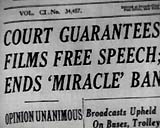
In a remarkable 9-0 unanimous decision in
1952 in the case of Burstyn v. Wilson, the Supreme
Court decided that the New York State Board of Regents
could
not ban The Miracle (1948), declaring movies
a form of free speech. The Court declared "sacrilege" too
vague a censorship standard to be permitted under the First
Amendment. (Note: This decision overruled the 1915 Supreme
Court decision in Mutual
Film Corp. v. the Industrial Commission of Ohio that
since moviemaking was a business, films didn't qualify
for the same First Amendment rights as other forms of expression.)
Film was finally freed from federal censorship,
although local censorship boards could still ban a film
deemed 'objectionable'. |
End of 'The Miracle' Ban
|
History
of Sex in Cinema: Greater Permissiveness and Expression
New Expressionism and Auteurism:
 Aspiring
French filmmakers in the New Wave 1950s proposed the auteur theory
(it was first advocated by François Truffaut in
1954). This was the idea that film was an art form and a means
of personal expression by a film's director. Explicit foreign
imports, such as Roger Vadim's flirtatious, sex-oriented ...And
God Created Woman (1957), the star-making hit for French/international
"sex kitten" Brigitte Bardot (Vadim's wife at the
time), caused waves of protest for being indecent, but further
pushed back the walls of censorship. Aspiring
French filmmakers in the New Wave 1950s proposed the auteur theory
(it was first advocated by François Truffaut in
1954). This was the idea that film was an art form and a means
of personal expression by a film's director. Explicit foreign
imports, such as Roger Vadim's flirtatious, sex-oriented ...And
God Created Woman (1957), the star-making hit for French/international
"sex kitten" Brigitte Bardot (Vadim's wife at the
time), caused waves of protest for being indecent, but further
pushed back the walls of censorship.
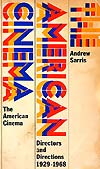
Andrew Sarris, the influential American film critic for the
Village Voice, who later served as editor of the film
magazine Cahiers du Cinéma, was a champion for
the auteur approach, first in his newspaper column with
"Notes on the Auteur Theory" (1962) and then in his
book The American Cinema: Directors and Directions, 1929-1968,
the unofficial Bible of auteurism. Other liberal European directors
in the 1970s (such as Bernardo Bertolucci's Last Tango in
Paris) brought about greater changes in cinema.
Greater Permissiveness and Tolerance:
These court decisions and attitudes reflected society's increasing
tolerance of mature themes in books, plays, and other forms
of mass entertainment, and the belief that censorship was becoming
obsolete. Challenges to the system, changing cultural attitudes
and liberalized, permissive morals brought about more evidences
of nudity and sexuality in Hollywood's films as a result. Also,
once the theatres were forced to be sold off by the studios
(due in part to a 1948 ruling which forced the separation of
the studios from their theatre chains), the owners had more
choice in the selection of films, and the burgeoning growth
of television brought further competition. Expressive 'art-house'
films from Europe brought the realization that sex in films
meant greater profits.
History
of Sex in Cinema: Ratings Systems
The Development of Ratings Systems:
 More
and more, with the loosening of standards and laissez-faire
controls, graphic sexual scenes, criminality and violence, and
coarse language were integrated into mainstream erotic films
and dramas (although it has often been demonstrated that erotica
in films doesn't necessarily guarantee greater box-office returns),
although they ran the risk of being challenged. The motion picture
industry officially abandoned the Hays Code in 1968. New voluntary
ratings systems were proposed by the Motion Picture Association
of America (MPAA), followed by age-based classification of films
(i.e., G, M, R, X) to protect children. Originally, the X-rating
wasn't trademarked or copyrighted, so adult film producers started
self-applying the X rating to their films on purpose (which
led to the invention of XX and XXX ratings for marketing purposes).
In 1990, the MPAA replaced X with NC-17 in an attempt to create
a non-stigmatized version of the adult rating. More
and more, with the loosening of standards and laissez-faire
controls, graphic sexual scenes, criminality and violence, and
coarse language were integrated into mainstream erotic films
and dramas (although it has often been demonstrated that erotica
in films doesn't necessarily guarantee greater box-office returns),
although they ran the risk of being challenged. The motion picture
industry officially abandoned the Hays Code in 1968. New voluntary
ratings systems were proposed by the Motion Picture Association
of America (MPAA), followed by age-based classification of films
(i.e., G, M, R, X) to protect children. Originally, the X-rating
wasn't trademarked or copyrighted, so adult film producers started
self-applying the X rating to their films on purpose (which
led to the invention of XX and XXX ratings for marketing purposes).
In 1990, the MPAA replaced X with NC-17 in an attempt to create
a non-stigmatized version of the adult rating.
Although relatively unchanged, various permutations
of ratings systems have evolved to the present day. For example,
M (or "Suggested for Mature Audiences") was replaced
by the GP (soon replaced with PG) rating in 1970, and the PG-13
rating appeared in 1984. Some critics have called the ratings
system a failure due to its subjective and arbitrary nature.
Many studios have circumvented the system by self-censorship
- lowering the rating of proposed films as much as possible
(by slicing out explicit sex and violence to avoid the dreaded
NC-17 rating), in order to bring in larger audiences.
History
of Sex in Cinema: Today
 Sex in Films Today:
Sexy
and erotic images in film scenes can be displayed in many varieties
and kinds of films. Sexual scenes may appear in art-house films,
horror/slasher films, erotic dramas, foreign-language films
and mainstream films. They may be 'old-fashioned,' risque, blatant,
mature, PG-13, excessive, suggestive, cheap, exploitative, outrageous,
innovative, infantile, soft-hued and soft-focused, campy, voyeuristic,
trashy, sensual, highly-charged, symbolic or visually metaphoric,
carnal, highly-choreographed and artsy, prurient or soft-core
NC-17.
Erotic films, unlike pornography, do not have as their
sole purpose the explicit and graphic display of sex and nudity.
Erotica sometimes is explicit, but can often be teasing, intriguing,
sylized, unique and imaginative. However, trends in recent art-house
films (that are unrated) suggest that simulated sex is becoming
more explicit, unsimulated sex - bordering on pornographic!
Although most theatrical releases are often edited to obtain
an R-rating, the DVD releases include the 'director's cut',
with unrated, explicit extras material. |