Romance Films: Romance films are love stories, or affairs
of the heart that center on passion, emotion, and the romantic, affectionate involvement
of the main characters (usually a leading man and lady), and the journey that
their love takes through courtship or marriage. Romance films make the love
story or the search for love the main plot focus. Oftentimes, lovers in screen
romances (often romantic dramas) face obstacles
and the hazards of hardship, finances, physical illness, racial or social class
status, occupation, psychological restraints, or family that threaten to break
their union and attainment of love. As in all romantic relationships, tensions
of day-to-day life, temptations (of infidelity), and differences in compatibility
enter into the plots of romantic films. Romance Films: Romance films are love stories, or affairs
of the heart that center on passion, emotion, and the romantic, affectionate involvement
of the main characters (usually a leading man and lady), and the journey that
their love takes through courtship or marriage. Romance films make the love
story or the search for love the main plot focus. Oftentimes, lovers in screen
romances (often romantic dramas) face obstacles
and the hazards of hardship, finances, physical illness, racial or social class
status, occupation, psychological restraints, or family that threaten to break
their union and attainment of love. As in all romantic relationships, tensions
of day-to-day life, temptations (of infidelity), and differences in compatibility
enter into the plots of romantic films.
Romantic films often explore the essential themes of love
at first sight, young (and older) love, unrequited love, obsessive love, sentimental
love, spiritual love, forbidden love, sexual and passionate love, sacrificial
love, explosive and destructive love, and tragic love. Romantic films serve
as great escapes and fantasies for viewers, especially if the two people finally
overcome their difficulties, declare their love, and experience life "happily
ever after" - implied by a reunion and final kiss.
Many romantic films do not have fairy-tale, wistful-thinking
stories or happy endings, although love serves as a shield against the harshness
of the real world. Although melodramas-tearjerkers and romantic comedies may have some
romance in their plots, they usually subordinate the love element to their
primary goal - to provide humor or serious drama.
The Earliest Romance Films:
Even films from the earliest days of silent cinema combined
romance, fantasy, and sex, as in the following films:
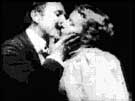 Thomas
Edison's early, 20-second long The May Irwin Kiss (1896) (aka The
Kiss, or The Irwin-Rice Kiss) was the most popular Edison Vitascope
film in 1896; it has been noted as the first filming of a couple's kiss
that was recreated from the two well-known stage actors' performance in
the hit Broadway play The Widow Jones; many considered it scandalous
to view two physically-unattractive people magnified on the screen during
an extended kiss Thomas
Edison's early, 20-second long The May Irwin Kiss (1896) (aka The
Kiss, or The Irwin-Rice Kiss) was the most popular Edison Vitascope
film in 1896; it has been noted as the first filming of a couple's kiss
that was recreated from the two well-known stage actors' performance in
the hit Broadway play The Widow Jones; many considered it scandalous
to view two physically-unattractive people magnified on the screen during
an extended kiss- Alexandre Dumas' famous story of a Parisian courtesan, Camille (1915), with Clara Kimball Young, was remade in the
silent era in 1917 (with Theda Bara), in 1921 (with Alla Nazimova and Rudolph
Valentino), and in 1927 (with Norma Talmadge)
- D.W. Griffith's Intolerance (1916) was subtitled, "Love's Struggle Throughout the Ages," and in one
of its four stories featured unrequited love between animal skin-wearing,
onion-eating Mountain Girl (Constance Talmadge) and Babylonian Prince Belshazzar
(Alfred Paget)
- glamorous Gloria Swanson became a star in Cecil B. DeMille's
romantic fable Male and Female (1919), that was based on James M.
Barrie's 1902 play "The Admirable Crichton" about class distinctions;
the film was noted for the actress' famous risque bathtub scene
- the Lon Chaney version of The Hunchback of Notre Dame
(1923) - a tragic tale of love between a deformed bellringer named Quasimodo
and gypsy dancer Esmeralda (Patsy Ruth Miller)
- Raoul Walsh's Sadie Thompson (1928) was the first film version of Somerset Maugham's classic novella about a loose-morals
San Francisco prostitute (Academy Award-nominated Gloria Swanson) and a
moralistic preacher/missionary (Lionel Barrymore) on the South Sea tropical
island of Pago-Pago; another version titled Rain (1932) from director
Lewis Milestone starred Joan Crawford and Walter Huston
- the beautiful actress Corinne Griffith starred as a destitute,
wide-eyed, and naive showgirl in Milestone's silent romantic comedy The
Garden of Eden (1928)
Rudolph Valentino: The Latin Lover
 Two
of the most prominent characters in silent romantic films were sexually-dangerous
and vixenish - epitomized by Rudolph Valentino and Theda Bara. The sexually-appealing,
charismatic Valentino was dubbed the "Latin Lover" after an illicit
tango dance in The Four Horsemen of the Apocalypse (1921). The exotic
star would also appear in a number of dramas, including Blood and Sand
(1922) as a bullfighter, Cobra (1925) as a notorious ladies man,
and The Eagle (1925) as a Russian cossack. He became a box-office male
superstar with his portrayal of a dashing Arabian sheik named Ahmed in a few
silent melodramas/costume adventures: Two
of the most prominent characters in silent romantic films were sexually-dangerous
and vixenish - epitomized by Rudolph Valentino and Theda Bara. The sexually-appealing,
charismatic Valentino was dubbed the "Latin Lover" after an illicit
tango dance in The Four Horsemen of the Apocalypse (1921). The exotic
star would also appear in a number of dramas, including Blood and Sand
(1922) as a bullfighter, Cobra (1925) as a notorious ladies man,
and The Eagle (1925) as a Russian cossack. He became a box-office male
superstar with his portrayal of a dashing Arabian sheik named Ahmed in a few
silent melodramas/costume adventures:
- The Sheik (1921) with co-star Agnes Ayres
- Son of the Sheik (1926) with co-star Vilmy Banky
Valentino's untimely death in 1926 at age 31, due to a perforated
ulcer and complications of peritonitis, led to an outpouring of grief from
legions of female fans for the heart-throb actor at his NY funeral.
 Theda
Bara: The Vamp Theda
Bara: The Vamp
Ohio-born Theodosia Goodman was an unsuccessful stage actress
(with the name Theodosia de Coppett) until she changed her name to Theda Bara
(Baranger was her maternal grandfather's last name) for Fox Studios in 1914.
[Theda Bara was an anagram for "Arab Death."] She instantly became
a major star in her first starring role as an exotic, sexually-aggressive femme fatale vamp character - in Frank Powell's melodramatic A Fool
There Was (1914) (also remade in 1922). She was noted for her seductiveness
and her often-repeated catchline request, "Kiss Me, My Fool," and
thereby became the first movie sex symbol. Only a few of her many films
survive to the present day (complete prints of her most famous films - Cleopatra
(1917) and Salome (1919), are non-existent).
Famous Screen Couples:
Garbo and Gilbert -
 Two
of the earliest romantic (or quasi-erotic) screen couples in the silent era
were the seductively-beautiful, beguiling and bewitching Greta Garbo and her
handsome screen counterpart John Gilbert, two MGM stars who first appeared
together in Flesh and the Devil (1926) with three artistically-lit extended sensual
love scenes. Reportedly, they had Hollywood's first French (open-mouthed) kiss on screen in a shadowy garden scene, and the
first-ever horizontal-position kisses in an American film. Garbo and Gilbert continued to carry on a passionate romance
both on- and off-screen. They also went on to make a loose adaptation of Tolstoy's Anna Karenina titled Love (1927). The film's original title
was changed from Heat, due to the awkward marketing that would have
developed (Gilbert and Garbo in 'Heat'). Soon after, they were paired in MGM's
melodramatic silent film A Woman of Affairs (1928), the story of a
tragic love affair for a fallen woman. [Later, Garbo's three greatest romantic
films were Queen Christina (1933), Camille
(1936) with the luminous actress as a dying Parisian courtesan in
love with a young nobleman (Robert Taylor), and Ninotchka (1939).] Two
of the earliest romantic (or quasi-erotic) screen couples in the silent era
were the seductively-beautiful, beguiling and bewitching Greta Garbo and her
handsome screen counterpart John Gilbert, two MGM stars who first appeared
together in Flesh and the Devil (1926) with three artistically-lit extended sensual
love scenes. Reportedly, they had Hollywood's first French (open-mouthed) kiss on screen in a shadowy garden scene, and the
first-ever horizontal-position kisses in an American film. Garbo and Gilbert continued to carry on a passionate romance
both on- and off-screen. They also went on to make a loose adaptation of Tolstoy's Anna Karenina titled Love (1927). The film's original title
was changed from Heat, due to the awkward marketing that would have
developed (Gilbert and Garbo in 'Heat'). Soon after, they were paired in MGM's
melodramatic silent film A Woman of Affairs (1928), the story of a
tragic love affair for a fallen woman. [Later, Garbo's three greatest romantic
films were Queen Christina (1933), Camille
(1936) with the luminous actress as a dying Parisian courtesan in
love with a young nobleman (Robert Taylor), and Ninotchka (1939).]
Gaynor and Farrell -
Another famous screen couple, dubbed "America's Lovebirds,"
were romantic film stars Janet Gaynor and Charles Farrell, eventually paired
together in twelve films. Their first film was Fox's Seventh Heaven (1927) with the popular theme song "Diane" - here was a classic romantic
melodrama set at the start of the Great War from talented romantic director
Frank Borzage. For their work in Seventh Heaven, Gaynor received the
first "Best Actress" Academy Award and Borzage received the first "Best Director"
Academy Award. An inferior remake was made in 1937.
Gable
and Crawford -
The romantic teaming of Gilbert and Garbo, and the vampishness
of Theda Bara was replaced by the arrival of new, sexy and romantic lead superstars
at MGM in the 1930s, typified by Clark Gable and Joan Crawford. (They were
also romancing each other off and on-screen at the time.) Their eight films
together included the following:
 Laughing
Sinners (1931), with Gable as a Salvation Army officer rescuing nightclub
entertainer Crawford after she was seduced by a traveling salesman Laughing
Sinners (1931), with Gable as a Salvation Army officer rescuing nightclub
entertainer Crawford after she was seduced by a traveling salesman- Dance Fools Dance (1931) with Crawford as a determined
crime reporter and Gable as a bootlegging gangster
- The Possessed (1931) with Crawford as the mistress
of Gable's NY attorney
- Dancing Lady (1933) a grand backstage musical drama
with Crawford as a young hopeful dancer, Gable as a Broadway musical producer
- and little-known Fred Astaire in his film debut
- Chained (1934) a sexy potboiler with the stars caught
in a love triangle
- Forsaking All Others (1935), a screwball comedy
about marriage
- Love on the Run (1936), an escapist romantic comedy
co-starring Franchot Tone (Crawford's real-life husband at the time) as
a rival journalist to Gable, released as a response to Columbia's Oscar-winning It Happened One Night (1934)
- Frank Borzage's Strange Cargo (1940) with Gable
as a convict on Devil's Island and Crawford as his loose girlfriend
Jean Harlow: The Original Blonde Bombshell
Wise-cracking, sassy, 'platinum blonde' Jean Harlow, one of
the original screen sirens, gave memorable, sensual performances in a number
of salacious dramas and lightweight romantic comedies, including the following:
 Hell's
Angels (1930), a Howard Hughes-directed film, with Harlow as the
sensual love interest of two WWI ace fliers; noted as the film where she
spouted, in a slinky dress: "Would you be shocked if I put on something
more comfortable?" Hell's
Angels (1930), a Howard Hughes-directed film, with Harlow as the
sensual love interest of two WWI ace fliers; noted as the film where she
spouted, in a slinky dress: "Would you be shocked if I put on something
more comfortable?"- Platinum Blonde (1931), a Frank Capra romantic comedy
with Loretta Young and Harlow as a socialite heiress; this film provided
Harlow with her nickname
- The Public Enemy (1931),
in a bit role as gangster James Cagney's short-term moll interest
- Red-Headed Woman (1932), a Victor Fleming romantic
drama, with Harlow as a manipulative gold-digger
- Red Dust (1932), as a chattering,
libidinous prostitute, stranded and flirtatious with rugged Indo-Chinese
rubber plantation overseer Clark Gable; this is the second of six films
that Harlow made with Gable
- George Cukor's Dinner at Eight
(1933),
a famous role as Kitty Packard, the chocolate-loving, bleached-blonde,
tough-talking, trashy, social-climbing trophy wife of tycoonish
financier Dan Packard (Wallace Beery)
- Victor Fleming's comedy Bombshell (1933), with Harlow
as a sexy, guileless movie star named Lola Burns - the "If" Girl
(based on Clara Bow's "It" Girl) who longed to settle down (a
reflection of Harlow's real-life situation)
- The Girl From Missouri (1934), noted as the first
of Harlow's films to be granted the Production Seal of Approval, with Harlow
as a gold-digging young woman named Eadie Chapman who was searching for
a millionaire husband; the original title of the film, Born to Be Kissed,
was censored
- China Seas (1935), as China Doll, the mistress of
Clark Gable - the Captain of a storm-tossed tramp steamer between Singapore
and Hong Kong
- Reckless (1935), another Victor Fleming film, a
tragic romantic melodrama based on the life of Broadway singer-performer
Libby Holman; this film was Harlow's top-grossing film to date
- Libeled Lady (1936), a classic screwball comedy
with a complex plot of romantic complications
- Saratoga (1937), Harlow's last, uncompleted film
(her 36th film over a 10-year period)
Tragically in June of 1937, she died (at the age of 26) of
uremic poisoning (and kidney failure) during filming with Gable (her sixth
film with him).
Classic Romantic Comedies:
 Classic
screwball romantic comedies of the 30's and 40s had involving zany plots,
unlikely romances or interesting pairings, and rapid-fire dialogue. [See the
section on screwball comedies for additional
information.] Representative films included, among others: Classic
screwball romantic comedies of the 30's and 40s had involving zany plots,
unlikely romances or interesting pairings, and rapid-fire dialogue. [See the
section on screwball comedies for additional
information.] Representative films included, among others:
- It Happened One Night (1934), Frank Capra's classic, award-winning
romantic cross-country trip and emerging mismatched romance between a street-smart
reporter (Clark Gable) and spoiled heiress (Claudette Colbert)
- My Man Godfrey (1936) with
William Powell as a down-and-out bum hired as a suave, redemptive butler
for the well-heeled but wacky Bullock family in Manhattan, including the
scatter-brained and zany heiress-daughter Irene (Carol Lombard)
- Mr. Deeds Goes to Town (1936),
Frank Capra's tale of a developing romance between a newly-rich hick (Gary
Cooper) and a tabloid journalist (Jean Arthur)
- The Awful Truth (1937),
with Cary Grant and Irene Dunne as a separated high-society couple - who
after lots of squabbling, romantic sabotage, and a custody battle (for their
dog) ultimately realized their true love for each other
 Nothing
Sacred (1937), in which Vermont woman Hazel Flagg (Carole
Lombard) believed to be dying from fatal radium exposure - a sensational
hoax of her own doing - was interviewed, entertained, and wined/dined
by a slick tabloid NYC reporter (Fredric March) Nothing
Sacred (1937), in which Vermont woman Hazel Flagg (Carole
Lombard) believed to be dying from fatal radium exposure - a sensational
hoax of her own doing - was interviewed, entertained, and wined/dined
by a slick tabloid NYC reporter (Fredric March)- Stage Door (1937), featuring
the female camaraderie of a group of aspiring actresses living together,
including Katharine Hepburn and Ginger Rogers
- Bringing Up Baby (1938), Howard Hawks' frantic, slapstick tale
of the courtship between a straight-laced museum paleontologist (Cary Grant)
and a zany heiress (Katharine Hepburn), with complications due to a pet
leopard named 'Baby'
- Holiday (1938), George Cukor's comedy about an anti-materialistic
Cary Grant with plans to marry socialite Doris Nolan, but when rejected
by her conservative father, falls in love with her black-sheep younger sister
(Katharine Hepburn)
- Made for Each Other (1939), a comedic romantic drama
of the real-life marital travails (financial and interfering in-laws) of
a recently-married couple (James Stewart and Carol Lombard)
- Midnight (1939), a witty and sophisticated romantic
comedy about marital conflicts, in a story about a penniless and struggling
young showgirl (Claudette Colbert) in Paris who was paid to impersonate
and masquerade as a Hungarian countess
 Ninotchka (1939), Ernst Lubitsch's wonderful film in which "Garbo
Laughs"; the frothy tale of how a stern and unsmiling Russian agent
(Garbo) was softened for love by a playboy Count (Melvyn Douglas) in the
City of Lights Ninotchka (1939), Ernst Lubitsch's wonderful film in which "Garbo
Laughs"; the frothy tale of how a stern and unsmiling Russian agent
(Garbo) was softened for love by a playboy Count (Melvyn Douglas) in the
City of Lights- His Girl Friday (1940), Howard Hawks' rewritten version of The
Front Page (1931), with lightning-paced dialogue and a love-hate relationship
between a divorced and estranged couple (newsman Cary Grant and star reporter
Rosalind Russell)
- My Favorite Wife (1940), a marital farce in which
widower Cary Grant's recent marriage to Gail Patrick was jolted when his
presumed dead wife (Irene Dunne) appeared after spending seven shipwrecked
years on a desert island with a handsome and virile scientist (Randolph
Scott)
- The Philadelphia Story (1940), from George Cukor, the witty romantic
entanglements between suitors Cary Grant, James Stewart, and spoiled socialite
Katharine Hepburn
- The Shop Around the Corner (1940), Ernst Lubitsch's
sentimental film of the anonymous, pen-pal romantic relationship between
bickering, lonely-hearts shop-clerks James Stewart and Margaret Sullavan
in old Budapest
 Ball
of Fire (1941), Howard Hawks' film about a group of seven stuffy professors
(one of whom is a gawky Gary Cooper) who were tutored in slang by a fast-talking
dame/moll (Barbara Stanwyck) on the run - a twist on the Snow White and
the Seven Dwarfs story Ball
of Fire (1941), Howard Hawks' film about a group of seven stuffy professors
(one of whom is a gawky Gary Cooper) who were tutored in slang by a fast-talking
dame/moll (Barbara Stanwyck) on the run - a twist on the Snow White and
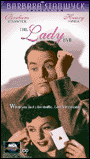
the Seven Dwarfs story- The Lady Eve (1941), Preston Sturges' intelligent, farcical romantic
tale of how a gold-digging, conniving con-artist (Barbara Stanwyck) fell
in love with her target - a snake-loving, hapless, gullible brewery heir
(Henry Fonda)
- The Palm Beach Story (1942),
another ludicrous Preston Sturges classic about the war between the sexes,
this time between an idealistic inventor/architect (Joel McCrea) and his
pragmatic beautiful wife (Claudette Colbert) during a soul-searching trip
to get a divorce in Florida
- The Talk of the Town (1942),
George Stevens' comedy about a man (Cary Grant) falsely accused of murder
and hiding out in the country home of a Harvard law professor (Ronald Colman)
and his landlady (Jean Arthur)
- The Farmer's Daughter (1947), with Loretta Young
as a Swedish farm girl who challenged her servant/boss (Joseph Cotten) for
his seat in Congress
 More
romance could be found in the puppy-love affairs of Mickey Rooney in the Andy
Hardy films of the late 1930s and 1940s. More
romance could be found in the puppy-love affairs of Mickey Rooney in the Andy
Hardy films of the late 1930s and 1940s.
Film Noirs: Destructive Romances
[See film noir genre section
on various femme fatales and lethal romances.]
Two representative romance/noir films, taken from James
M. Cain novels, The Postman Always Rings Twice (1946) and Double Indemnity (1944), were seething with lustful, self-destructive
romantic relationships, between a femme fatale and an entrapped male
partner (Lana Turner-John Garfield, Barbara Stanwyck-Fred MacMurray). In the
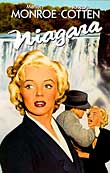
twisted tale of infidelity and mystery by director Henry Hathaway, Niagara
(1953), a sexy, scheming Marilyn Monroe plotted the murder of her unstable
husband (Joseph Cotten) on their honeymoon at the falls. |

 Romance Films